-2-4.png)
Event planners around the world eagerly watched every detail of Taylor Swift and Travis Kelce’s anticipated fairytale garden wedding at Madison Square Garden this summer, as if it were our Super Bowl.
Guests didn't walk away from Taylor's wedding describing an arena. They walked away describing a feeling, and that doesn't happen by accident. Someone decided exactly what that feeling should be, and built every detail toward it.
Anyone can host an event, but an experience stays with your guests long after they’ve gone home. A memorable experience builds trust, strengthens relationships, and leaves a lasting impression.
The difference isn't a bigger budget. It's intentionality, and it's what turns a gathering into a powerful extension of your brand.
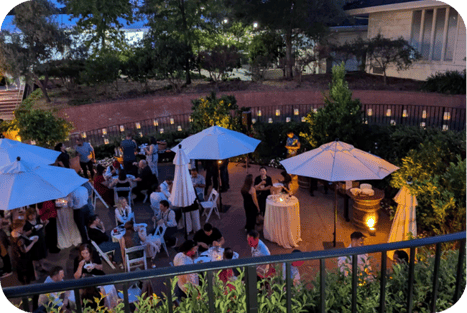
A warm client reception in Napa, California.
start with the experience, not the checklist
Define your purpose first. What do you want guests to feel? What story are you telling? What conversations do you hope they'll have? What do you want them to remember, or do, after they leave?
This is the step most people skip. It's tempting to pick a date, book a venue, hire your favorite vendors, and let the "feeling" of the event sort itself out along the way. But the feeling is the point. Everything else, the room, the run of show, the food, the entertainment, exists to serve it. Decide what you want people to walk away with first. Then build backward from there.
Even Madison Square Garden, of all places, got treated this way. Guests described an arena completely transformed. Every detail was in service of the feeling, not the other way around.
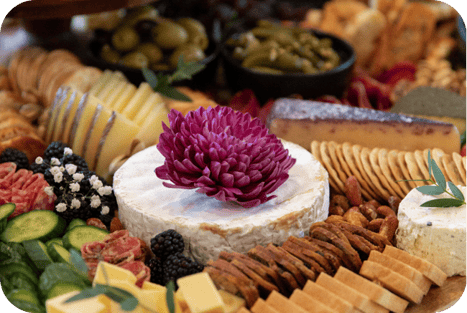
Beautiful details from a Fat Baby Marketing celebration in Austin, Texas.
every touchpoint tells your brand story
Décor, invitations, entertainment, food, favors: treated individually, these are just logistics. Treated as chapters of one story, they become a single, cohesive feeling, the sense that every piece of the night was telling the same story.
Even the smallest details at Taylor's wedding reportedly pointed back to their love story and Taylor's brand. Guests went home with a romantic keepsake tying directly to Taylor’s music—delicate lace handkerchiefs embroidered with the lyric "so it's gonna be forever" and a monogrammed T framed by two hearts. Taylor walked down the aisle to an instrumental version of her own song, "Love Story." The romance continued with an arena floor covered in grass-like carpeting and filled with towering, live trees, ferns, and whimsical floor to ceiling draping, creating the illusion of an outdoor fairytale garden. A peach-colored entryway opened into a rose garden-inspired reception, the romantic color palette carrying through from one space to the next.
That's the model: every touchpoint is an opportunity to reinforce your brand and your goals for the event. Guests don't experience these moments separately; they experience them as one cohesive story.
But the story only works if it’s actually yours.
Instead of asking "what does everyone do at an event like this," ask what fits you, your brand, and your audience. Breaking convention isn't the goal, and neither is playing it safe. What matters is that every choice is made on purpose and reflects who you are. Skip what doesn't serve you, keep what does, and don't be afraid to try something unconventional if it's true to you. Guests can tell the difference between a choice that feels random and one that’s authentic.
Where Taylor and Travis broke from tradition—digital invitations instead of paper, a dessert bar instead of a cake, a "man of honor" instead of a maid of honor—it read as personal rather than random, because it reflected the couple.
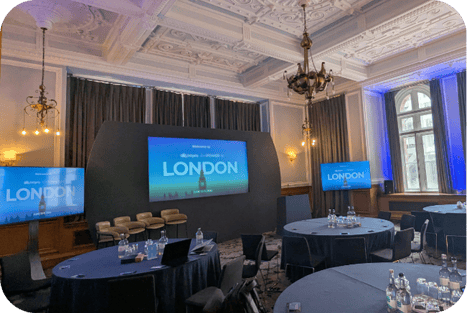
A client's conference brought to life in London, England.
a little mystery goes a long way
The venue for Taylor's wedding was never confirmed publicly ahead of time. No official photos were ever released. Guests arrived through private, covered drop-off tents outside Madison Square Garden, complete with closing black curtains and a secure entry route completely hidden from paparazzi and public view. There was a strict no-phone policy in place for guests, vendors, and security alike.
Even the "leaks," an invitation photo here, a guest's Instagram post there, likely weren't leaks at all. A wedding this controlled almost certainly planned exactly what would surface and when, each one timed and managed with care.
That secrecy didn't kill the conversation. It fueled it; people who weren't even invited were following along, guessing, wanting to be part of it. There's a reason exclusivity creates buzz: what's hidden becomes something people want in on.
- Guest lists that don't leak.
- Venues that stay unconfirmed until the last possible moment.
- Photos that never officially surface, leaving only secondhand accounts and guesswork behind.
That kind of restraint builds anticipation before the event and curiosity after it.
For your own events, this doesn't mean going dark on marketing. It means being deliberate about what you reveal, when, and to whom. A save-the-detail here, a teaser there, a hinted surprise, or maybe a guest list that feels like an invitation rather than an open door. Mystery makes people lean in, and an event people are talking about before it starts is already working.
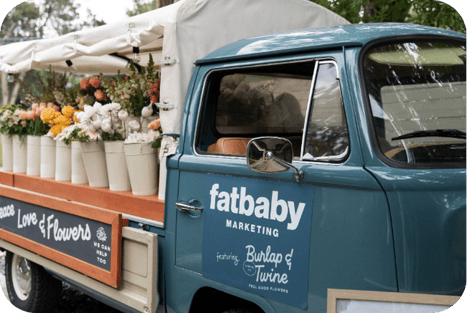
Unique experiences and brand activations in Austin, Texas.
behind every experience are hundreds of tiny decisions
The best events often feel effortless, and that’s never by accident. It's the result of hundreds of decisions made long before the first guest arrives, most of which the guest will never know happened at all.
A star-studded, two-day celebration with buffet stations, at least 30 cakes, back-to-back performances from Paul McCartney and Stevie Nicks, arcade games, raffles for designer handbags and a vintage car, and dancing doesn't happen because it was left to chance. Someone mapped out every hour, twice over.
- Timing. The run of show gets planned down to the minute so that a toast, a performance, and a course of food never collide.
- Coordination. Every vendor gets aligned, so they're all building toward the same night instead of just showing up and doing their own thing.
- Contingency. Someone thinks through what happens if a performer runs long, a delivery is late, or the weather doesn't cooperate, so a guest never notices anything went sideways.
Details and micro planning are the unglamorous part of every great event. It rarely gets talked about, but it’s what makes everything else possible. And it's the same thinking we bring to the events we plan for our clients.

the event isn't the finish line
Great events continue creating value after everyone goes home. It’s telling that guests at Taylor’s wedding, media, and fans are still recounting details, weeks later. That's what a well-designed experience does: people become your storytellers all on their own.
You can help extend the life of your own event as well. Send the thank-you. Follow up on the conversations that started there. Repurpose the photography and footage for your socials and your next pitch. The event itself is just the beginning of the return on it. What you do in the weeks after is what stretches the value of everything you just built.
the takeaway
Anyone can host an event. Few create something guests are still describing, unprompted, days later. That's not just luck.
Your next gathering, conference, client dinner, or milestone celebration doesn't need Taylor Swift's budget to get that right. But it does need intention, a clear idea of how you want people to feel, and great planning to get there.
All Taylor Swift wedding details referenced are based on guest accounts and media reporting, not official confirmation from the couple.
-2-3.png)